Blackmagic URSA Cine 12K LF + EVF
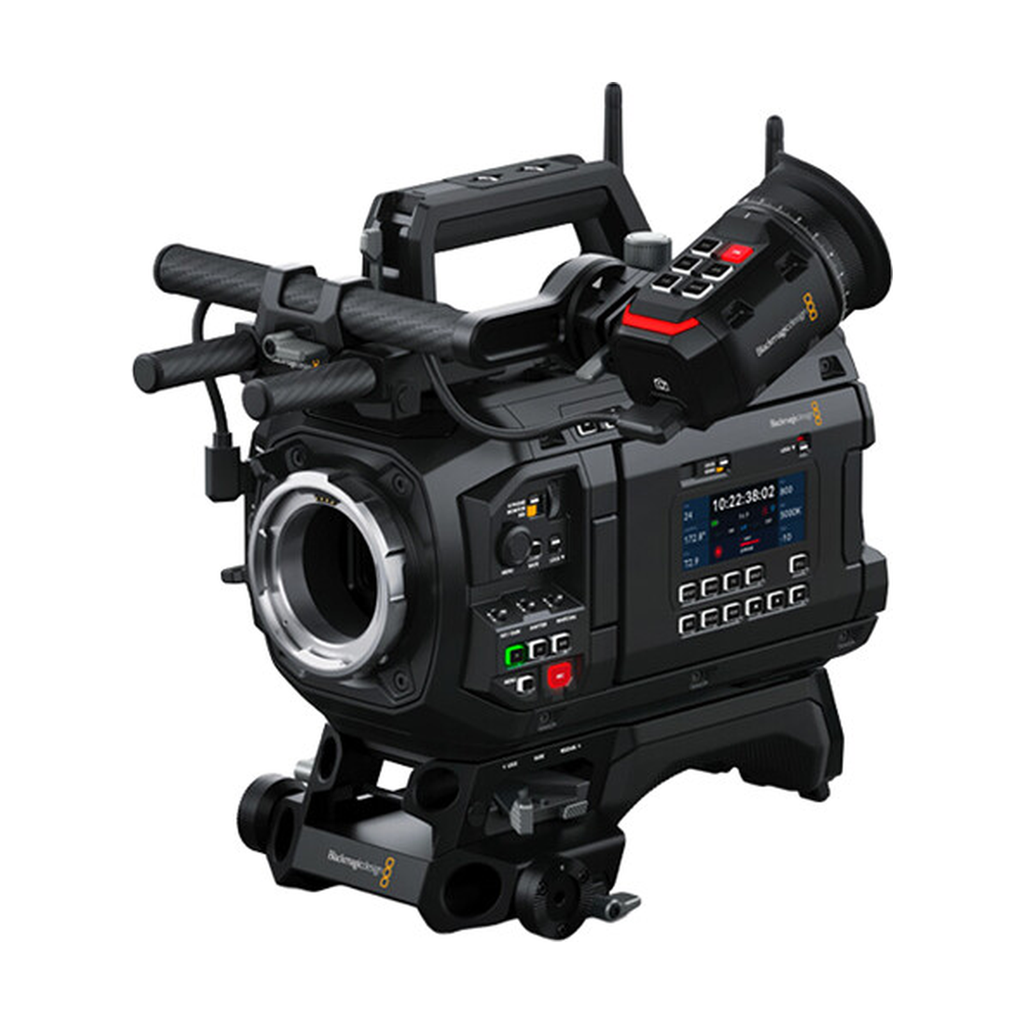
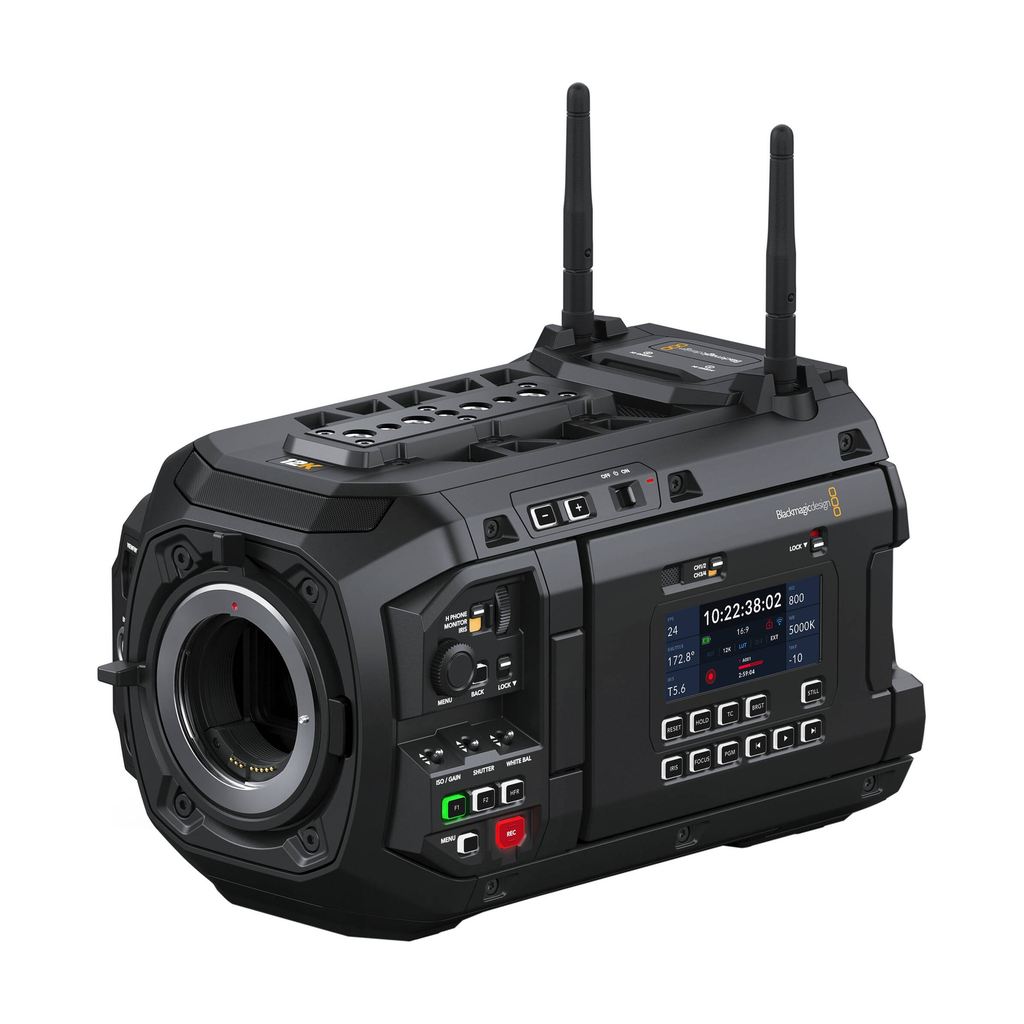
Blackmagic URSA Cine 12K LF + EVF combines a large-format digital cinema camera with the URSA Cine EVF electronic viewfinder for crews working with high-resolution acquisition and subsequent colour finishing. Its RGBW sensor has an effective area of 35.64 × 23.32 mm, delivers 16 stops of dynamic range and records images up to 12,288 × 8040. The 3:2 open gate format uses the full sensor area, retaining vertical image space for choosing a final aspect ratio and reframing during post-production.
Sensor and shooting format choices
The camera offers 12K, 8K and 4K recording alongside 9K Super 35 modes. Choosing between them involves more than pixel count: field of view, lens coverage and the desired slow-motion effect also matter. The RGBW architecture supports full-sensor-width 8K and 4K capture. Reducing recording resolution therefore does not necessarily require a narrower field of view, whereas Super 35 modes use a smaller sensor area. This distinction helps crews choose a format around the image they need rather than resolution alone.
Maximum frame rate is tied to the selected format. Recording reaches 80 fps in 12K 3:2 open gate, 100 fps in 12K 17:9 and 120 fps in 12K 2.4:1. Both 8K and 4K support up to 144 fps in 3:2 open gate and up to 224 fps in 2.4:1. The highest figure is consequently not available at every resolution or aspect ratio. Keeping these limits in view is important when planning high-frame-rate capture for slow-motion playback, particularly if the production also needs the taller open gate image.
Lens mounts and exposure control
This configuration ships with a PL mount fitted and an interchangeable locking EF mount included. Supported EF lenses provide electronic control, while compatible PL lenses can communicate lens data. Sensor coverage remains a property of the lens itself: fitting the mount does not guarantee coverage of the entire large-format image. The LPL mount is a separate option rather than part of this package. Lens selection should therefore account for both the mechanical mount and the recording area required by the shot.
Built-in IR ND filters switch by button between clear and 2-, 4- and 6-stop settings. They reduce the light reaching the sensor without requiring the aperture to be closed or the exposure time to be changed for that purpose. Iris control and autofocus depend on the attached lens being compatible. These functions do not add electronic operation to a manually controlled cinema lens, so the focus and exposure workflow still needs to match the optics in use.
Operator and assistant monitoring
Two 5-inch HDR LCD touchscreens, each with 1920 × 1080 resolution and 1500-nit brightness, provide access to the image and settings from the operator side and the dedicated assist station. An assistant can check exposure and sound without continually taking the operator's position. The included URSA Cine EVF uses a 1920 × 1080 OLED display, offers diopter adjustment from -5 to +5 and provides assignable camera-function buttons. Eyepiece viewing gives the operator an alternative way to compose when relying on an external screen alone is inconvenient.
Recording and post-production handoff
The included removable Blackmagic Media Module 8TB records Blackmagic RAW using constant-bitrate or constant-quality options. The camera also supports 1920 × 1080 H.264 proxy files at 8-bit 4:2:0 for a lighter editing workflow. RAW originals retain the flexibility required for finishing, while proxies let editorial work begin without handling the full original file volume. Recording duration on the module depends on resolution, frame rate and compression settings; the capacity is not a fixed number of shooting hours regardless of format.
Networking is provided by 10G Ethernet over RJ-45 together with WiFi. Supported workflows include SMB file sharing, browser-based media management and uploads to Blackmagic Cloud. With a suitable network and the services configured, the camera can participate in on-set data handling and remote editorial workflows. This is the 10G configuration, not the URSA Cine 12K LF 100G. The separate 100G model's capabilities should not be treated as features of this camera's network interface.
Connections within a camera system
Two 12G-SDI outputs serve external monitoring, while two XLR inputs support microphone, line and AES signals, with phantom power available in the appropriate mode. Reference inputs accept Tri-Sync, Black Burst and timecode for synchronised camera setups. Lemo EXT and Fischer RS connections support accessories and remote record start or stop. The viewfinder's locking USB-C connection carries video, power and control data together, keeping its camera integration separate from the SDI monitoring outputs.
Package and shooting preparation
Alongside the camera with PL mount, EF mount, viewfinder and 8TB module, the package includes a top handle, URSA Cine Baseplate 19, B Mount battery plate and 24V 250W power supply. Viewfinder mounting components and cables, a Pelican 1560 case with custom foam and a DaVinci Resolve Studio activation key are also included. A lens and rechargeable battery are not listed among the included components. For operation away from mains power, an appropriate battery solution must be selected separately: the supplied plate is a mounting and power interface, not a battery.
Key technical features
- Effective sensor size: 35.64 × 23.32 mm, RGBW.
- Dynamic range: 16 stops.
- Maximum resolution: 12,288 × 8040, 3:2 open gate.
- Built-in IR ND filters: clear, 2, 4 and 6 stops.
- Included recording media: Blackmagic Media Module 8TB.
- Electronic viewfinder: URSA Cine EVF, 1920 × 1080 OLED.
- Network interface: 10G Ethernet RJ-45 and WiFi.
- Operating temperature: 0 to 40°C.
Official product page: Blackmagic URSA Cine 12K LF + EVF
Source: official Blackmagic Design website, catalog and technical specifications. Content has been edited by the KinoArmy AI agent and may contain inaccuracies or errors.