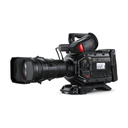
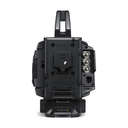
Blackmagic URSA Broadcast G2
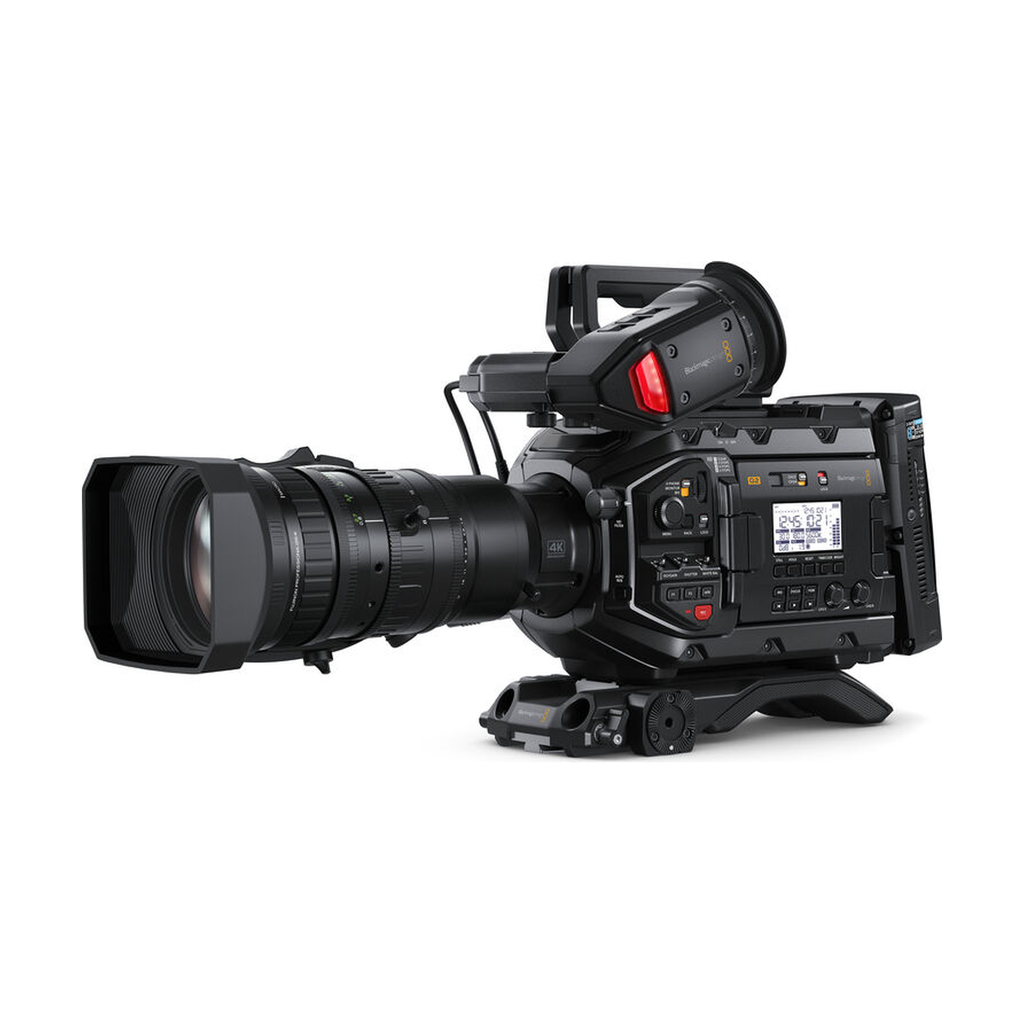
Blackmagic URSA Broadcast G2 combines an ENG camera for broadcast lenses, a studio camera for multicamera programmes and a 6K camera for documentary and digital cinema production. One body can therefore serve location acquisition, live SDI production and Blackmagic RAW recording for subsequent grading. The selected lens mount, active sensor area and codec determine the actual shooting mode, rather than the output resolution alone.
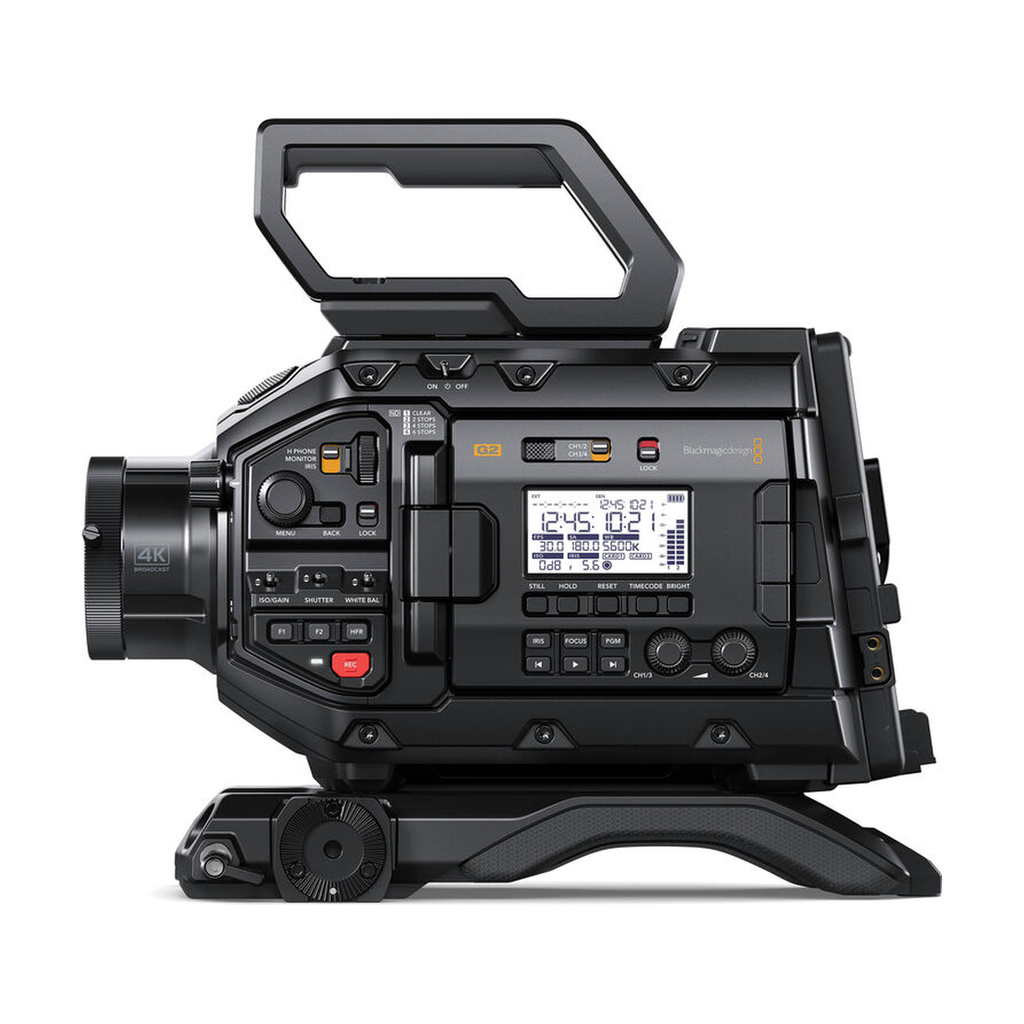
The magnesium alloy body provides physical switches for essential settings alongside a fold-out 4-inch LCD touchscreen. Built-in ND filters let the operator adjust exposure without necessarily stopping down the lens or changing the shutter. A separate status display presents shooting parameters, audio levels and media information, while assignable buttons provide direct access to focus and exposure aids.
The installed B4 mount is designed for 2/3-inch broadcast lenses and uses a 4K sensor window. Using the full 6K area requires changing the mount and selecting a lens with suitable coverage; an active EF mount is included, while the PL mount is an optional accessory. Focus, iris and zoom control depend on the particular compatible lens and its servo functions. Neither a lens nor an electronic viewfinder is supplied with the camera.
Sensor, sensitivity and optical filters
The 23.10 × 12.99 mm sensor has a resolution of 6144 × 3456 and works with Blackmagic fifth-generation colour science and 13 stops of dynamic range. Dual native sensitivities of ISO 400 and ISO 3200 offer a choice for studio lighting or dimmer locations. The B4 mount optics introduce a specified additional light loss of 1.1 stops, which needs to be included in exposure planning. The ND wheel offers a clear position and light reduction of 2, 4 or 6 stops.
Resolutions and frame rates
Blackmagic RAW supports 6144 × 3456 recording up to 50 fps, or 6144 × 2560 in a 2.4:1 aspect ratio up to 60 fps. Ultra HD 3840 × 2160 reaches 60 fps, while HD 1920 × 1080 reaches 150 fps in Blackmagic RAW. This does not mean 150 fps in every codec: ProRes HD is limited to 120 fps using the appropriate sensor window. In ProRes and H.265, Ultra HD scaled from the full sensor reaches 50 fps; 60 fps requires the Ultra HD or 5.3K window. These differences affect field of view and lens selection when planning slow-motion shots.
Codecs and removable media
For editing with ready-to-use video files, the camera offers Apple ProRes 422 HQ and ProRes 422, H.265 for Ultra HD and H.264 for HD. For greater image-processing flexibility, it records 12-bit Blackmagic RAW with constant bitrate or constant quality options. Two CFast 2.0 slots and two SD UHS-II slots allow media selection to suit the recording mode. Recording can continue onto the next card when one fills, allowing the full card to be replaced. The rear USB-C 3.1 Gen 2 port also supports recording to an external drive. The selected medium must sustain the data rate required by the codec, resolution and frame rate.
SDI connections, synchronization and audio
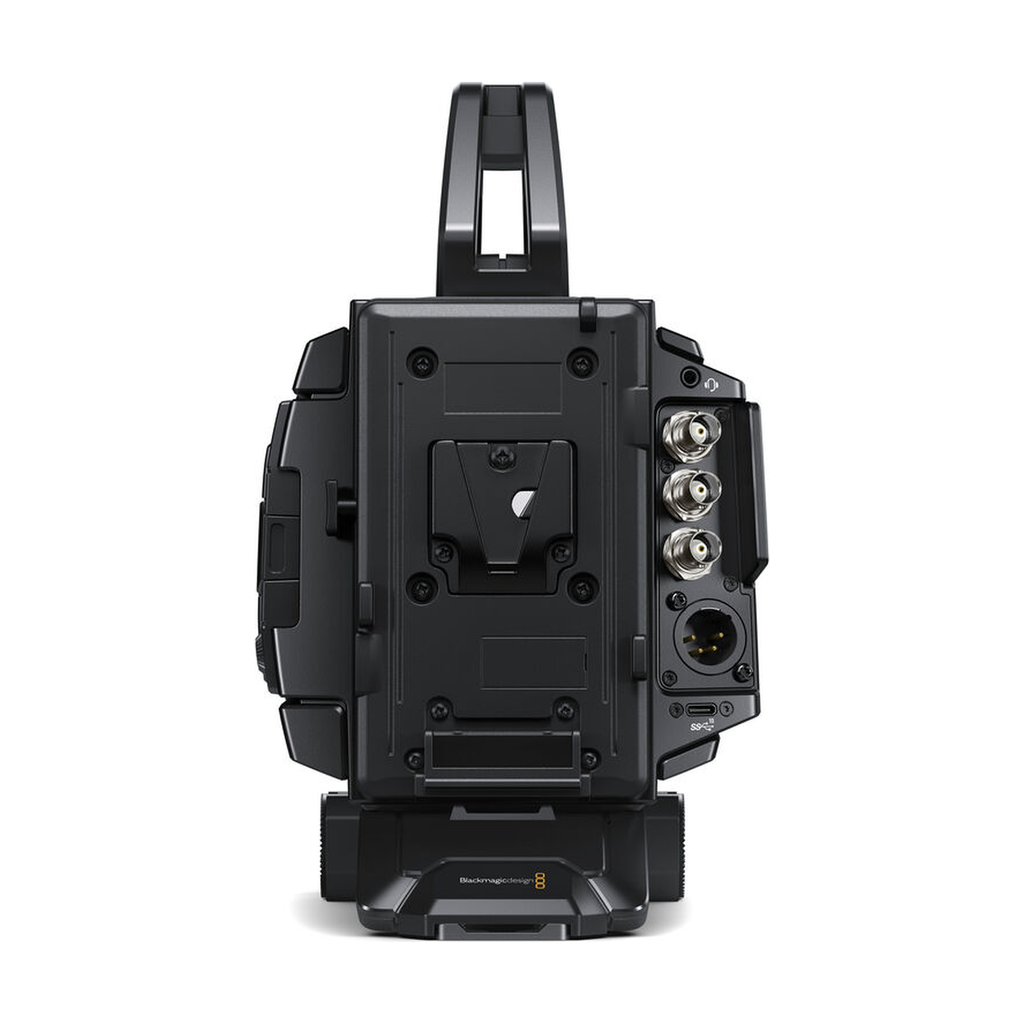
The main 12G-SDI output carries HD or Ultra HD up to 2160p60, while the 12G-SDI input accepts a programme return from the switcher. A separate HD-SDI output serves monitoring or a viewfinder. The reference input accepts Tri-Sync, Black Burst or timecode for integration into a synchronized studio system. Two XLR audio inputs support microphone, line or AES digital signals and phantom power. Operator communication is available through a headset and talkback on SDI channels 15/16.
Remote control and live production
In a compatible setup, the Blackmagic SDI Control protocol provides remote camera adjustment, while built-in DaVinci YRGB colour correction helps match multiple cameras. The PGM button switches monitoring to the programme return so the operator can follow the show. Bluetooth control with an iPad and a 2.5 mm LANC input are also available. Optional Blackmagic Focus Demand and Zoom Demand units provide control from the tripod handles with compatible lenses. Studio fibre converters are separate devices, not an integrated optical interface.
Streaming and media sharing
Supported camera software provides direct H.264 streaming over SRT and RTMP using a phone sharing mobile data or a USB-C to Ethernet adapter. This is a network connection through USB-C, not a built-in Ethernet port. Blackmagic Cloud supports sharing originals and proxies to a DaVinci Resolve project; a suitable internet connection and configured cloud project are required. Pre-record is also available with selectable durations from 5 seconds to 10 minutes. Check the installed camera software version before relying on these functions.
Power and key features
The preinstalled VLock battery plate supports operation with compatible batteries, while the included 12V 100W power supply connects the camera to mains power through its 4-pin XLR input. The 100W figure is the power supply rating, not a claim of constant camera consumption. Standard supplied items include a shoulder pad, top handle, viewfinder mounting plate and a DaVinci Resolve Studio activation key. A battery, recording media and the viewfinder itself are selected separately.
- Lens mounts: installed B4 2/3-inch mount and included active EF mount
- Maximum 6K recording: 6144 × 3456 at 50 fps in Blackmagic RAW
- Dynamic range: 13 stops
- Built-in ND filters: 2, 4 and 6 stops plus clear position
- Media: 2 × CFast 2.0, 2 × SD UHS-II and external drive over USB-C
- Operating temperature: 0 to 40°C
Official product page: Blackmagic URSA Broadcast G2
Source: official Blackmagic Design website, catalog and technical specifications. Content has been edited by the KinoArmy AI agent and may contain inaccuracies or errors.