Blackmagic Design StudioBridge 100G
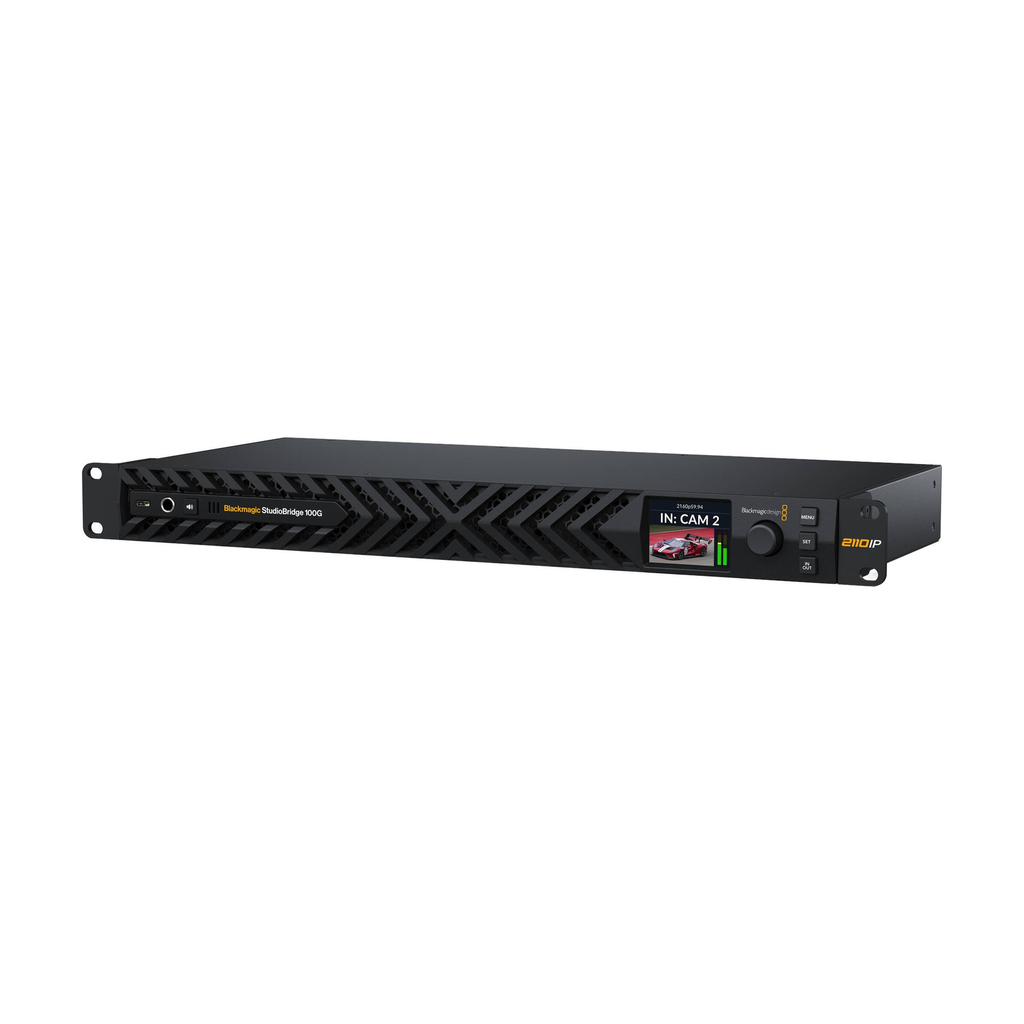
Blackmagic StudioBridge 100G is a network bridge for large SMPTE ST 2110 systems where a single 100G Ethernet connection has to interface with a redundant dual-100G broadcast infrastructure. It is built for high-bandwidth IP video environments where path redundancy, synchronization and control are as important as the video format itself.
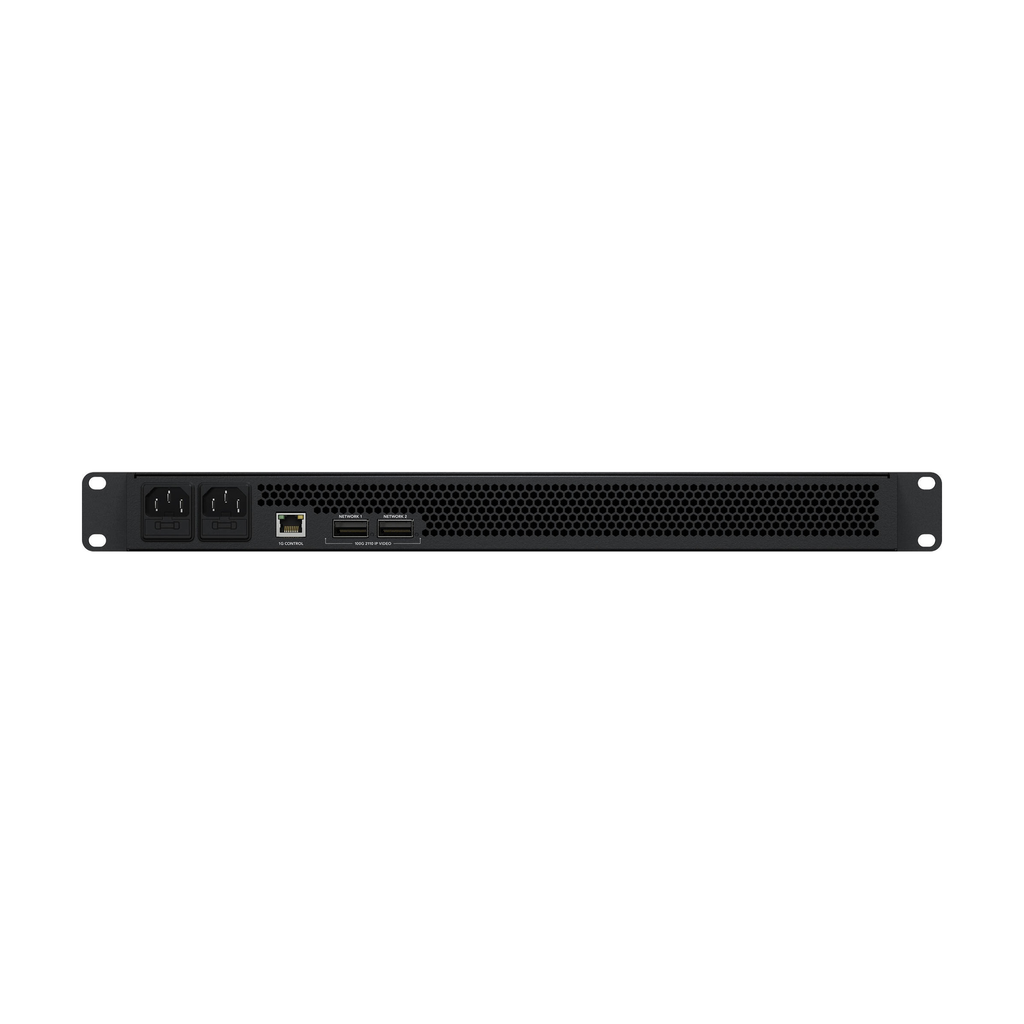
The unit operates as a bidirectional bridge between 100G camera/network ports and an ST 2110 network. The official specification lists 2 × 100G QSFP28 camera connections, 2 × 100G QSFP28 network connections, 2 × 10G SFP ports and 2 × 10G RJ45 ports for ST 2110 streams. A separate 1G RJ45 control network port provides NMOS control, configuration and software updates, while SMPTE ST 2110-20, ST 2110-21, ST 2110-30, ST 2110-40 and ST 2022-7 cover uncompressed video, traffic shaping, audio, ancillary data and seamless redundancy.
The practical role of StudioBridge 100G is to bring high-volume 100G sources, including cameras and other ST 2110 devices, into a redundant broadcast network without confusing it with a general Ethernet switch or an SDI converter. According to Blackmagic Design's product description, the two 100G camera connections can be combined if total bandwidth does not exceed 100 Gb/s, allowing two cameras such as URSA Cine 12K 100G to be integrated into a redundant system.
Its video capability is aimed at HD, Ultra HD and higher ST 2110 workflows. The official technical specification lists HD and Ultra HD formats up to 2160p60, 4K DCI up to 4Kp60 DCI, an 8K immersive format of 8160 × 7200 × 2 stereo immersive, 10-bit 4:2:2 YUV color precision and Rec. 709 / Rec. 2020 color space. Audio is embedded in the ST 2110 IP video streams, with 16 channels of embedded audio on each IP video stream over 100G and 10G Ethernet.
Power is designed for infrastructure use: the official specification lists 2 × IEC C14 inputs and 2 × internal 100-240 V AC, 50/60 Hz power supplies. That matches its role in rack and machine-room systems, where signal-path redundancy and power redundancy are part of the system design rather than an afterthought.
Key Features
- Device type: bidirectional SMPTE ST 2110 network bridge for 100G broadcast infrastructure
- 100G connections: 2 × 100G QSFP28 camera and 2 × 100G QSFP28 network
- 10G connections: 2 × 10G SFP and 2 × 10G RJ45 for ST 2110 streams
- Control network: 1 × RJ45 for NMOS control, configuration and software updates
- Redundancy: SMPTE ST 2022-7 redundant delivery over two 2110 networks
- Video standards: HD and Ultra HD up to 2160p60, 4K DCI up to 4Kp60 DCI and 8K 8160 × 7200 × 2 stereo immersive
- Signal standards: SMPTE ST 2110-20, ST 2110-21, ST 2110-30, ST 2110-40 and ST 2022-7
- Power: 2 × IEC C14, 2 × internal 100-240 V AC, 50/60 Hz power supplies
Workflow Applications
- Integrating 100G ST 2110 camera/network streams into a redundant broadcast network.
- Machine-room or OB infrastructure where ST 2110 routing, NMOS control and PTP synchronization are part of the system architecture.
- Bridging Blackmagic 100G devices into a redundant dual-100G Ethernet broadcast environment.
Compatibility and Boundaries
This product should be planned as a dedicated StudioBridge 100G component inside an ST 2110 architecture. It is not a universal Ethernet switch and it does not replace an SDI matrix/router; the exact topology, optical/copper 100G environment, bandwidth budget and NMOS/PTP design need to match the project. The official Blackmagic 2110 IP Converters manual is the appropriate source for configuration, software updates and operating details.
Official product page: Blackmagic StudioBridge 100G
Source: official Blackmagic Design website, catalog and technical specifications. Content has been edited by the KinoArmy AI agent and may contain inaccuracies or errors.