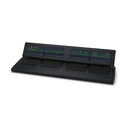
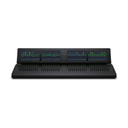
Blackmagic Design Fairlight Live Audio Panel 40
Blackmagic Design Fairlight Live Audio Panel 40 is a large desktop hardware control surface for Fairlight Live, designed for professional live audio mixing. It is not a standalone analog mixer; it is the physical control layer for the software-based Fairlight Live environment. The 40 motorized fader model is aimed at television studios, sports and concert productions, OB systems, large live streaming control rooms and installations where an operator needs many channels within reach without constantly banking through a small controller.
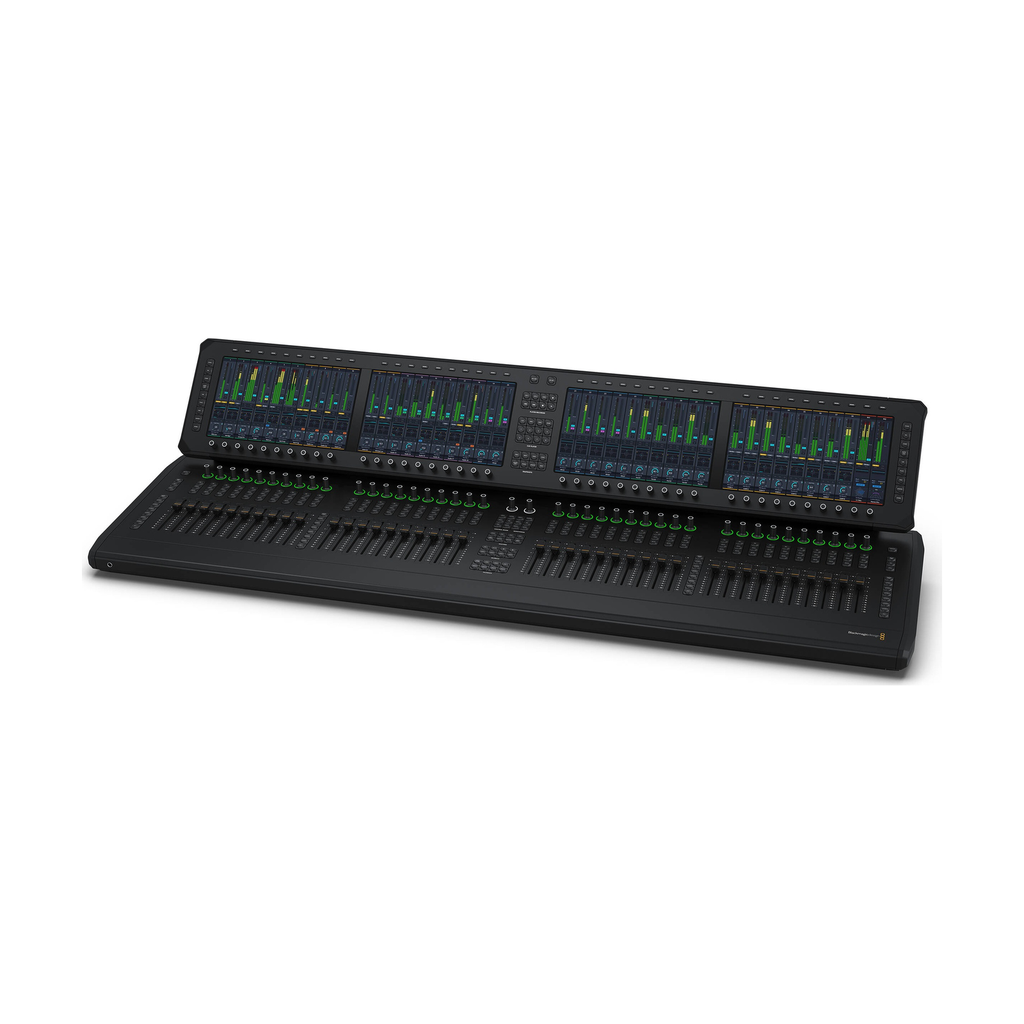
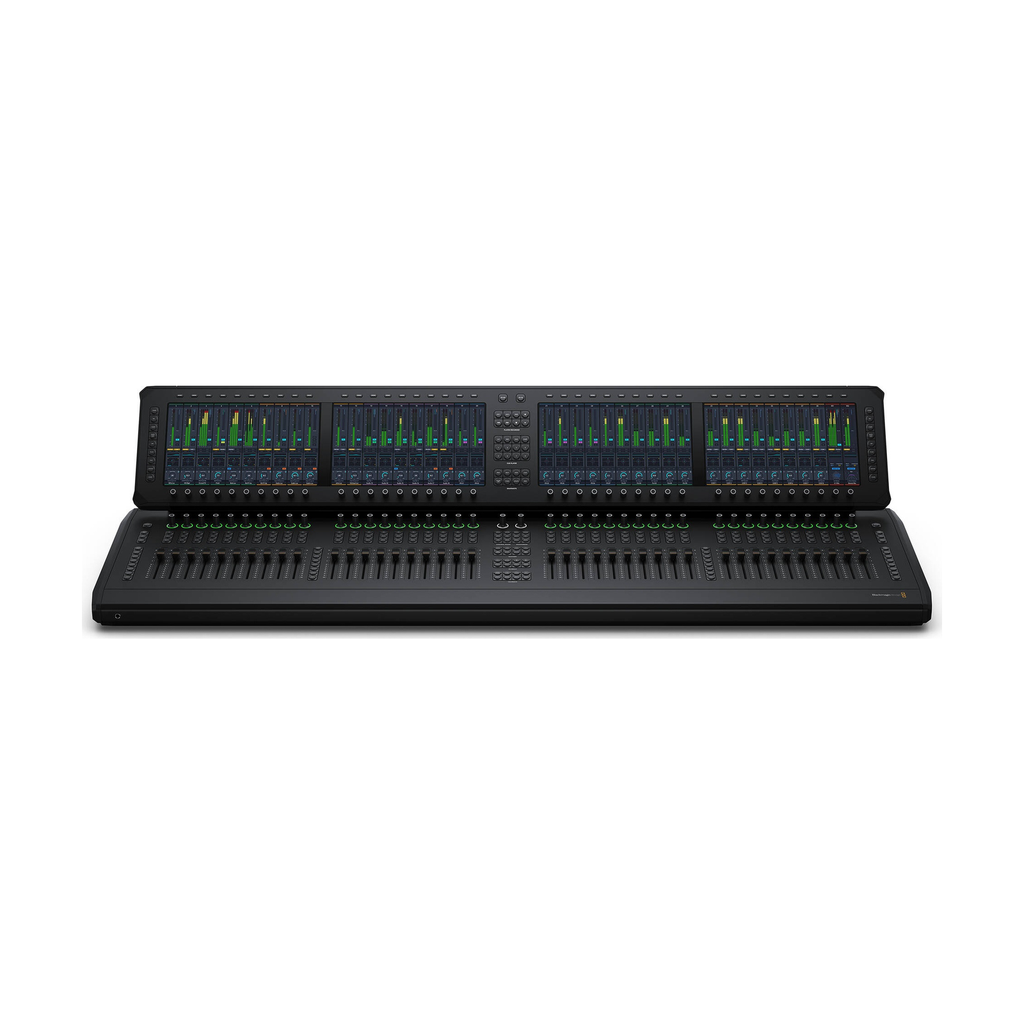
In operation, the panel turns Fairlight Live from an on-screen system into a familiar console workflow. Four 11.6-inch 1920 × 1080 touchscreen LCD displays show channel information, levels, EQ, dynamics processing and plug-in interfaces, while the 40 flying faders follow the active layers and mix state. This matters in shows with presenters, guests, commentator positions, program feeds, clean feeds, IFB, music sources and talkback communication, where the engineer has to react quickly without losing orientation.
Fairlight Live is built around a modern SMPTE 2110 broadcast workflow, integration with ATEM live production switchers, snapshots, mix-minus, broadcast routing, talkback and multi-user operation. Audio Panel 40 is the widest desktop surface in the range and provides more simultaneous fader access than Audio Panel 10 or Audio Panel 20. It is therefore suited to productions where active channels, aux sends, bus groups, matrix paths and sub-master sections need a larger physical control area.
Role in the live audio workflow
The panel's main role is to give the audio operator physical control over the mix while Fairlight Live handles the software, network and routing side of the system. Each channel strip combines a motorized fader, solo, mute and select buttons, a rotary encoder and visual feedback from the display. In large formats this lets inputs, buses and sends be arranged in layers while still feeling like a real console in front of the operator.
The panel is especially useful in broadcast and event scenarios where different parts of the production change quickly: studio discussion, live remote contribution, music performance, commercial break, replay, commentary segment or remote source. The Snapshots keypad supports storing and recalling mixer settings and configurations, while the player/recorder and cue player areas support virtual sound checks, rehearsals, stingers and MIDI cue operations when those are part of the installation.
Channel strips and tactile control
The 40 flying faders are the defining difference of this model. They motorize to match the current layer, so the physical position reflects the active mix state rather than an old position from another page. Each strip has a multi-function rotary knob with LED ring indicator and separate Select, Solo and Mute buttons. Additional contextual rotary knobs and contextual buttons work with the lower and upper rows of the focus and view screens, reducing the need to search through menus.
The Channel Focus area provides processing and input controls for the selected channel. This creates a logical combination of instant access and detailed adjustment: the operator selects a channel with a physical button, sees its status on the display and adjusts specific parameters with rotary controls. In a multichannel production this organization helps the mix remain readable even when a single strip controls multiple tracks or buses according to the Fairlight Live configuration.
Connectivity and signal infrastructure
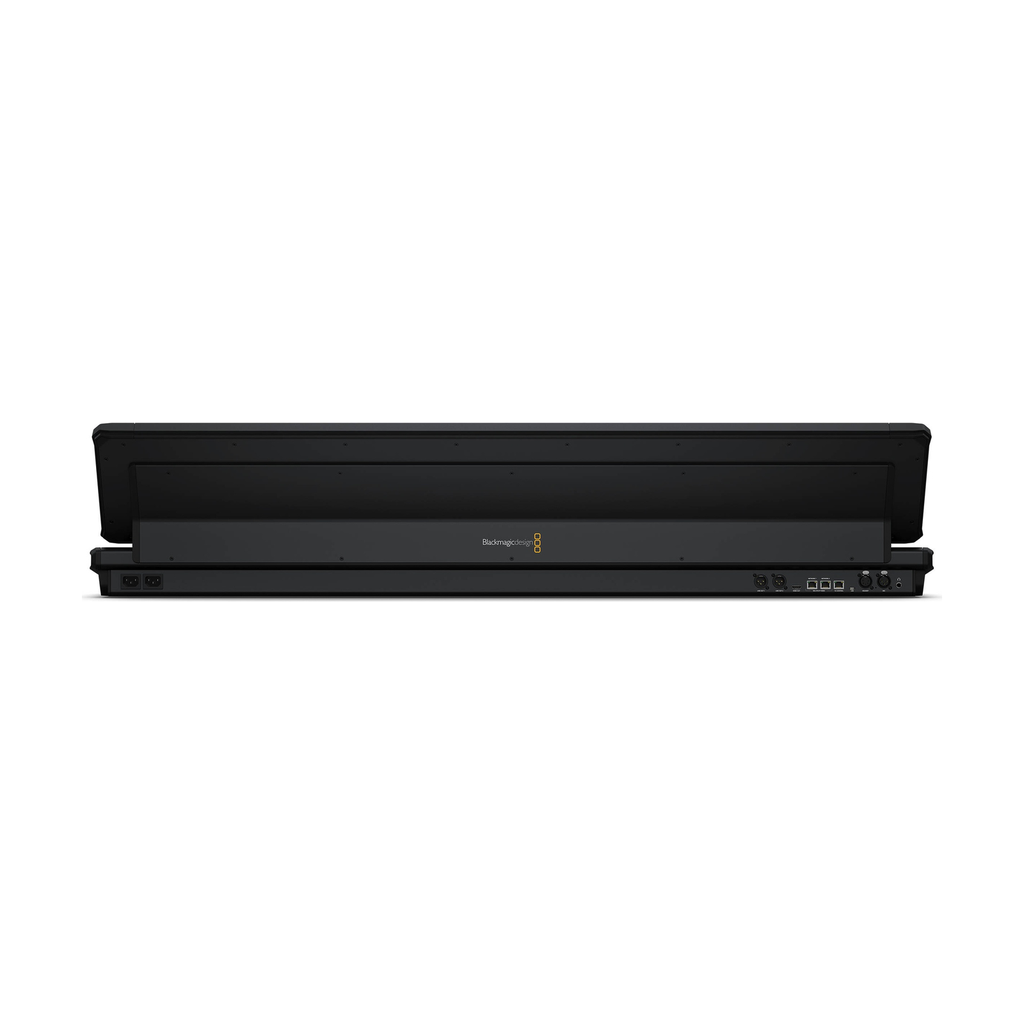
The official technical specification for Fairlight Live Audio Panel 40 lists 2 x 10G RJ45 Ethernet connections for 2110 IP video and audio networks. Each 10G pair supports 2110 IP video and audio plus analog audio into and out of the panel. A separate 1G RJ45 control network is used for computer connection, configuration and software updates, while the USB Type-C port is used for computer connection, software configuration and updates. The HDMI Type A output enables video monitoring from a 2110 IP workflow, including program or multiview depending on the system configuration.
The analog section is focused on monitoring and talkback. The panel includes a 3-pin XLR mic level input, a 5-pin XLR talkback headset connection, two 3-pin XLR line level outputs, one 5-pin XLR talkback headset output and two 6.35 mm headphone outputs. This allows local listening, talkback communication and integration into a production communication environment without presenting the device as a standalone audio interface or mixer outside the Fairlight Live system.
Displays, monitoring and visual feedback
The four built-in 11.6-inch touchscreens are important not only as displays but as part of the control logic. They show VU meters, mixer status, channel strip information, levels, EQ, dynamics processing and plug-in interfaces. When a function is selected, the display changes to a task-based view with a parameter area and a level control area. This keeps visual context on the selected channels while the physical controls remain under the operator's hands.
The HDMI output supports HD or Ultra HD monitoring formats. The specification lists 720p50/59.94/60, 1080i50/59.94/60, 1080p23.98/24/25/29.97/30/50/59.94/60 and 2160p23.98/24/25/29.97/30/50/59.94/60. This is a monitoring output in the context of a 2110 IP system, not a promise of separate video processing outside the documented Fairlight Live workflow.
Talkback and communication
The talkback section is built for live production communication. The panel includes a built-in talkback microphone, talkback to 4 groups, direct to channel and ALL selection, a dedicated cue mode button and access to the talkback setup screen. In practical use this allows the operator to speak to talent, announcers, technical crew or a specific channel without interrupting mix operation. Support for latched and momentary operation is useful during sound checks, rehearsals and live changes.
The available XLR and headphone connections make the communication section usable in a real control room environment: headset, microphone, headphones and local monitor outputs can connect directly to the panel. This does not remove the need for a properly designed intercom, monitoring and network infrastructure, but it gives the Fairlight Live operator a dedicated communication area inside the control surface itself.
Key capabilities
-
Model: Fairlight Live Audio Panel 40
-
Device type: desktop hardware control surface for Fairlight Live
-
Motorized faders: 40 flying faders
-
Touchscreen displays: 4 x 11.6 inch 1920 × 1080 LCD touchscreens
-
Channel controls: Select, Solo and Mute for each channel
-
Rotary controls: 40 multi-function rotary knobs with LED ring indicators plus 40 contextual rotary knobs
-
Contextual buttons: 40 contextual buttons for functions and parameters on the focus and view screens
-
2110 IP network: 2 x 10G RJ45 Ethernet for IP video and audio workflows
-
Control network: 1 x 1G RJ45 for connection, configuration and updates
-
Computer interface: USB Type-C for computer connection, software configuration and updates
-
Video monitoring: 1 x HDMI Type A, HD or Ultra HD
-
Analog audio input: 1 x 3-pin XLR for mic level audio
-
Analog audio outputs: 2 x 3-pin XLR line level outputs and 2 x 6.35 mm headphone jacks
-
Talkback: built-in microphone, 5-pin XLR headset connection, 4 talkback groups, direct to channel and ALL
-
Power: 2 x internal 100-240 V AC, 50/60 Hz power supplies with 2 x IEC C14 sockets
-
Included software: Fairlight Live and Blackmagic OS; internal software upgrade via updater application
Practical applications
Panel 40 is suitable for television studios, sports commentary productions, large streaming control rooms, live music broadcast, worship and event installations, OB trucks and broadcast facilities moving toward IP-based SMPTE 2110 infrastructure. In these situations the operator manages not only input channel levels but also aux sends, matrices, sub-masters, VCA groups, talkback groups, monitoring sources and show snapshots. The large physical surface reduces reliance on mouse and keyboard operation during critical live changes.
In smaller systems, Fairlight Live can be used with more compact control panels or as a software environment. Choosing Audio Panel 40 makes sense when direct access to 40 faders and four screens is a real operational requirement. If the production has few channels, limited desk space or does not use Fairlight Live as the main live audio system, a smaller model or another configuration may be the more appropriate choice.
Compatibility and real limits
The device should be treated as part of the Fairlight Live ecosystem. It requires a suitable Fairlight Live installation, compatible host computer, correct network topology and the appropriate audio, video and control endpoints. The officially listed operating systems are Mac 15.0 Sequoia, Mac 26.0 Tahoe or later and Windows 11. Functions such as ATEM integration, NMOS routing, SMPTE 2110, snapshots, AFV, remote operation and multi-user workflows depend on the complete system, software versions and actual configuration.
The panel should not be described as a standalone mixer, recorder or general purpose audio interface. It has analog audio and talkback connections, but their role is within the Fairlight Live control surface and production monitoring workflow. Facts from other models in the range should not be carried over: Audio Panel 10, Audio Panel 20 and Audio Panel 40 have different fader and display counts, and this proposal is for the exact 40-fader BM-DVFL/AAFLP40 model.
Why choose Panel 40
The strongest reason to choose Audio Panel 40 is the scale of direct control. More faders mean less banking, better orientation in a wide channel layout and faster response during live changes. The four touch sections provide more visual area for meters, channel focus, parameters and overview, while the motorized faders keep the physical position synchronized with the current layer and mix state. For operators accustomed to large live consoles, this makes the software-based Fairlight Live system feel more natural to operate.
For KinoArmy, this product is best suited to projects where Fairlight Live is planned as the central live audio platform rather than a peripheral addition. Before final configuration, channel count, routing, monitoring, talkback, ATEM integration, 2110 network design, desk space and power should be confirmed. That allows Panel 40 to be selected as the correct control surface for the scale of the production, rather than simply as the largest model in the series.
Official product page: Fairlight Live Audio Panel 40
Source: official Blackmagic Design website, catalog and technical specifications. Content has been edited by the KinoArmy AI agent and may contain inaccuracies or errors.