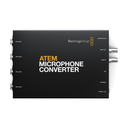
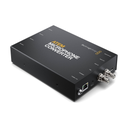
Blackmagic Design ATEM Microphone Converter
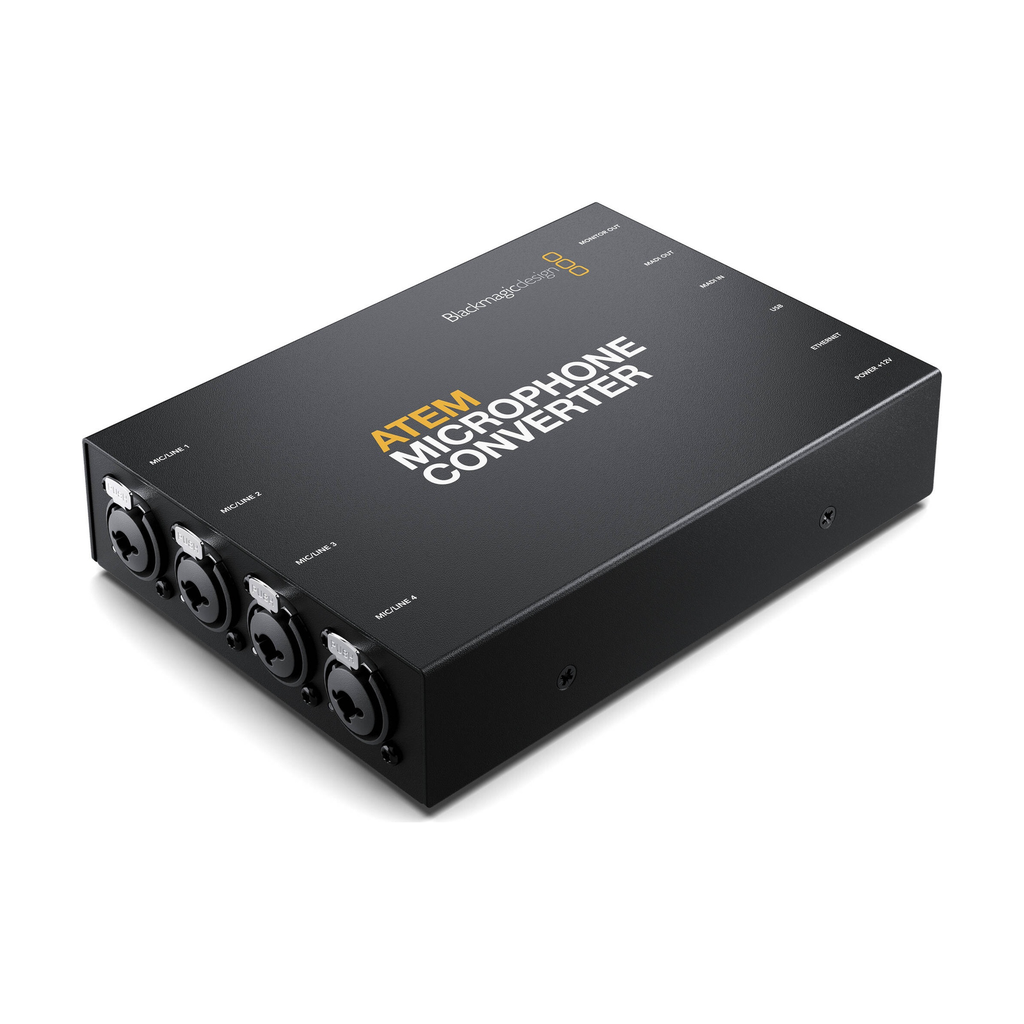
Blackmagic Design ATEM Microphone Converter converts four analog microphone or line-level signals into digital audio over MADI. It adds separate audio sources to an ATEM switcher with a MADI input, such as microphones for a studio panel discussion or outputs from an external audio mixer. Each source remains a separate channel for subsequent mixing rather than arriving as a pre-mixed stereo feed.
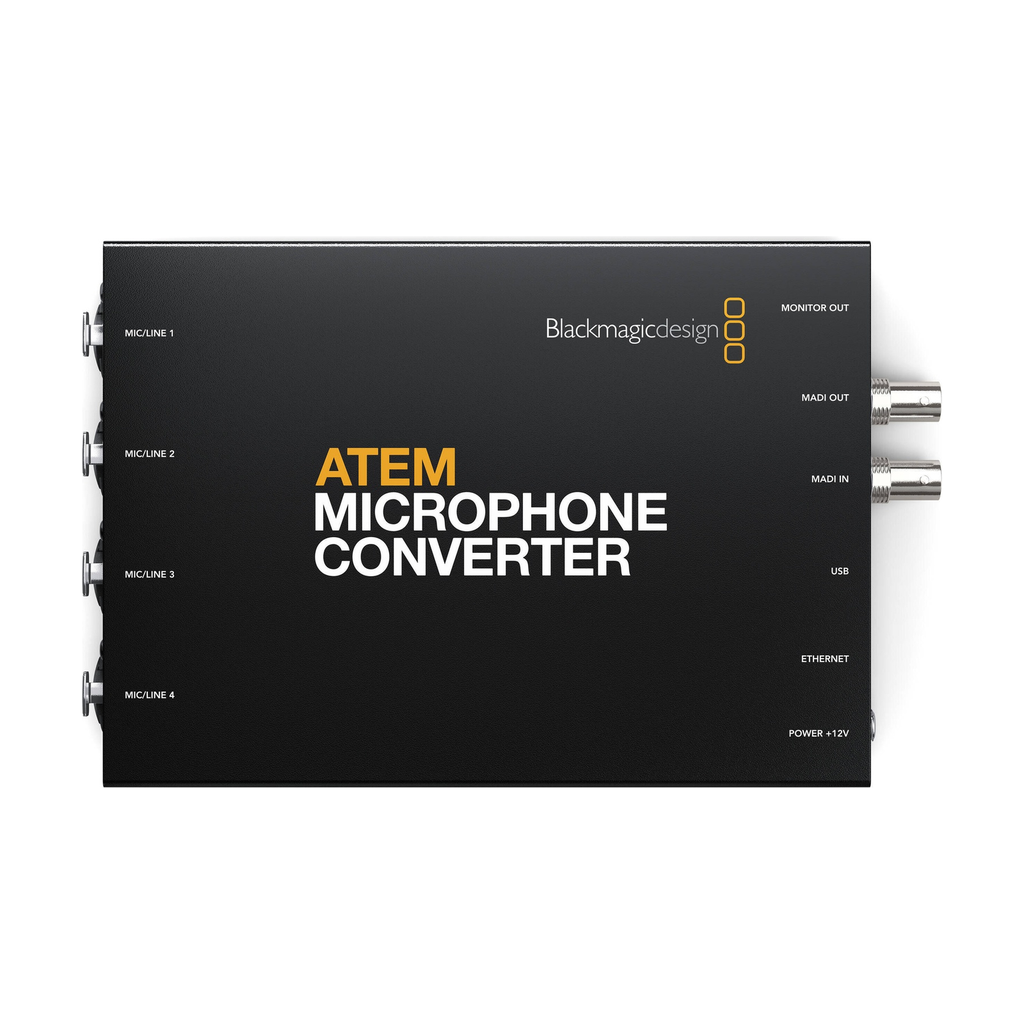
The four combination inputs accept 3-pin XLR or balanced 6.35 mm TRS jack connections. Side switches select microphone or line level and enable +48 V phantom power for the corresponding input; selecting line level disables phantom power. Eight analog-to-digital converters work together on each input channel. This architecture provides a dynamic range of 131 dB(A), a noise floor of -129 dBV and total harmonic distortion of 0.002% at full scale. Digital preamplification uses internal 32-bit processing, while the MADI output delivers 24-bit audio at 48 kHz.
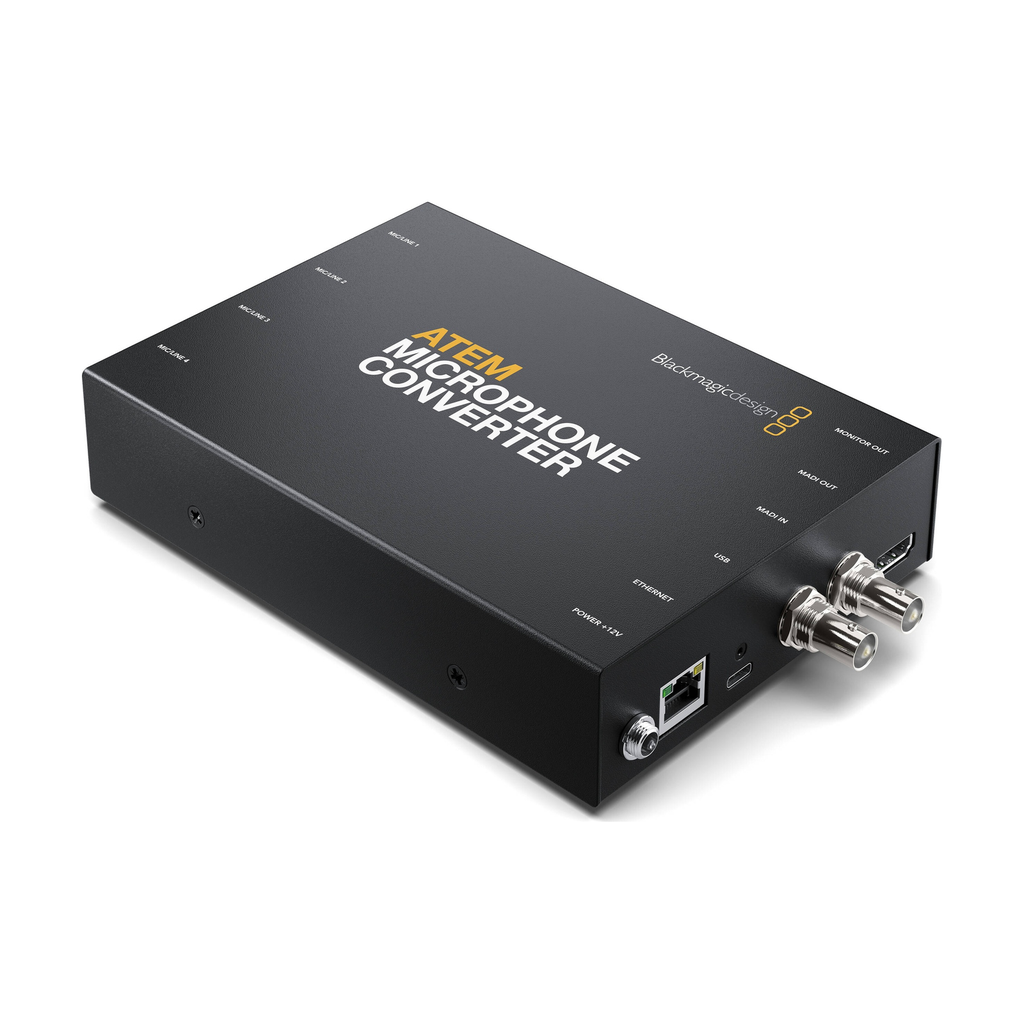
The converter suits teams expanding the microphone inputs of an existing ATEM system without running a separate analog cable for each channel all the way to the switcher. The MADI connection uses BNC connectors and 75 Ω coaxial cable over distances up to 100 m, as specified in the manual. A compatible MADI input is required: SDI or HDMI connections alone on a switcher do not provide this connection. The converter's HDMI port provides visual audio monitoring on an external screen, rather than serving as a video input.
Expansion over MADI
A single converter places its four analog inputs on MADI channels 1, 2, 3 and 4. The MADI input allows additional converters to be daisy chained, adding their channels after the local group of four. The BNC input and output support 64-channel MADI under AES10-2020, but the usable channel count also depends on the receiving switcher. This does not mean that one converter has 64 physical microphone inputs.
Visual monitoring and configuration
The HDMI output displays scrolling audio waveforms covering the last 60 seconds, VU meters and channel names. Its layout adapts to 4, 8, 12 or 16 channels as converters are daisy chained. With three or more converters, some information is hidden to make room for the additional channels; microphone/line and phantom power settings can be checked in the utility or on the hardware switches. Beyond four converters, additional monitor connections are needed to view the subsequent groups.
Blackmagic Converters Setup manages input names and colors, digital gain up to +30 dB per input and network settings. Computer connectivity is provided over USB-C or Ethernet, including internal software updates. Network configuration supports DHCP and static IP addressing. Once input levels are set, the final balance is shaped in the ATEM audio mixer.
Key features
- Analog inputs: 4 × combination XLR/TRS, microphone or line level.
- Phantom power: +48 V, disabled when line level is selected.
- MADI connections: 1 × BNC input and 1 × BNC output, 64 channels, AES10-2020.
- Output audio format: 24-bit/48 kHz.
- Analog-to-digital conversion: 8 converters per input.
- Dynamic range: 131 dB(A).
- Noise floor: -129 dBV.
- Total harmonic distortion: 0.002% at full scale.
- HDMI monitoring: up to 16 channels with a 60-second waveform history.
- Administration: USB-C and Ethernet 10/100/1000 BASE-T.
- Power: included external 12 V DC supply with locking connector; operating range 12 to 17.5 V DC.
- Maximum power consumption: 12 W.
- Operating temperature: 0 to 40 °C.
Official product page: Blackmagic Design ATEM Microphone Converter
Source: official Blackmagic Design website, catalog and technical specifications. Content has been edited by the KinoArmy AI agent and may contain inaccuracies or errors.